Showing posts with label summer reading. Show all posts

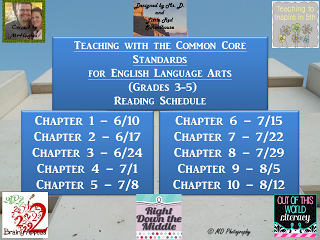
ELA Summer Book Club- Chapter 3


Reading Standards for Informational Text


This chapter offered a plethora of information on reading informational texts. It stated, “Many teachers and school districts have built their reading instruction with fiction as the center, giving informational reading short shrift.” How true is this for classrooms across the United States? Across the world?

The standards for informational text reading are broken into four groups:

1. Key Ideas and Details
2. Craft and Structure
3. Integration of Knowledge and Ideas
4. Range of Reading and Level of Text Complexity

According to the reading in Chapter 3, there are four guidelines that can help when designing the instruction for creating competent reading of informational text. One is to “always use more than a single text with students.” You can provide supplemental informational readings in addition to your novel or textbook story. This allows the students to examine the various texts and come up with similarities and differences in the texts.

 A second guideline is to “help students identify some of the most commonly used text organizational patterns in informational materials.” For this guideline, one word resonates in my head: MODEL. It is imperative that teachers model for the students what their expectations are. If we do not model for them, then they have no idea of how to find what is needed. Opportunities for looking at different organizational patterns in text are needed for students to become deeper thinkers while reading. Encouraging teachers provide these opportunities and the support needed to help students reach their potential. 

Here is an example given in the text of the progression of skills for grades 3 through 5 for RI.3.5, RI.4.5, and RI.5.5 (Craft and Structure):

3rd Grade: Use text features and search tools (e.g., key words, sidebars, hyperlinks) to locate information relevant to a given topic efficiently
4th Grade: Describe the overall structure (e.g., chronology, comparison, cause/effect, problem/solution) of events, ideas, concepts, or information in a text or part of a text
5th Grade: Describe the overall structure (e.g., chronology, comparison, cause/effect, problem/solution) of events, ideas, concepts, or information in a text or part of a text


A third guideline is “students need to take an active role in thinking about the text ideas as they read.” For classrooms that have not incorporated a lot of informational texts, this may take a little longer to master. Students need to be taught how to ask and answer questions to demonstrate their understanding of a text. Thinking deeply about texts is a must in CCSS classrooms. 

A fourth guideline is “when reading informational texts, remember that these are authored just as pieces of fiction are, and attention to the author and the quality of the written text can help students understand the role of authorship and writing across genres.”

Using the CCSS throughout the school day will be easier for teachers who have developed units using themes from science and social studies. I love the example the author gives of Ms. Scalin's classroom integrated unit on butterflies. When you read how someone else has been successful in the classroom, it generates more ideas to use and gives examples of how to design your own units. Because science and social studies lends themselves to informational reading, it makes sense to build units around topics that fit into your grade level. 

I have included three discussion questions in the comments section below. Please add your thoughts to the questions. If you have other questions, please feel free to add them as a separate comment. 

If you missed Chapter 1, CLICK HERE. If you missed the post about Chapter 2, CLICK HERE. 


Rockin' Read Alouds


Who doesn't love a rockin', good book to read aloud to your students? As a language arts teacher, I love reading books aloud to my students. I think the students enjoy the read aloud time just as much as I do. Each summer, I look for new books to introduce into my classroom. I have more time to read books that I think my students will enjoy, create something to go along with the books, and then get ready to hook my readers with a captivating book. 

Generally, I teach three language arts classes per day. We always begin our day with our daily grammar practice to get their minds in ELA mode. As soon as we have completed this activity, we transition into our read aloud time. Here are some of my favorite read aloud books that I use in my classroom. 


1. The Outsiders by S.E. Hinton

This is one of my all-time favorite books! Although it is a book that has been circulated throughout classrooms for a while now, it is still a book that students absolutely L.O.V.E.! I remember reading it as a middle school student, so I was more than excited to be able to use it as one of my first read aloud novels my first year as a classroom teacher. Now, 11 years later, I still love teaching it just as much as the first time. The students love the adventure and realness of the book. It portrays two social classes who do not get along too well, but as the book unfolds, they begin to realize how many things they actually have in common. The students can relate to this because of the cliques formed in school. If you have not used this book as a class read aloud, I would highly recommend it for sixth and/or seventh grades.  I have created a Novel Study for The Outsiders that I use in my classroom whenever I use this novel. 


2. Follow the Drinking Gourd by Jeanette Winter
This is an excellent picture book to read aloud to students in third and fourth grade. It fits in with a study on the American Civil War, so if you teach a Civil War Unit, incorporating this book adds so many dimensions. Originally a folk song sung by slaves, Follow the Drinking Gourd provided a map for those slaves wanting to escape to freedom. In this book, the author cites one family’s journey along the Underground Railroad, using illustrations to go along with the words of the folk song. Students love this book because it helps them understand the process easier.  Click HERE to be directed to a unit that goes along with this wonderful read aloud. 


3. Lawn Boy by Gary Paulsen
In this short novel, students learn how investing money can pay off big in the long run. Gary Paulsen is a favorite author of many of my male students, so I love to use his work anytime I get the opportunity. This short novel can be used in any classroom when an Economics Unit on supply and demand is being taught. After reading the book, many students try to imagine what they could do to turn a little bit of income into a huge sum of money, based off of a simple summer job. I have created a Novel Study to use with this thrilling book. 


4. Glory Be by Augusta Scattergood
I read this novel last summer because I picked it up from our school book sale at the end of the year. Being a newly written novel, I was excited because I would get to share it with my students and it would be a fresh, new book that many had not read. It is set during the time of the Civil Rights Movement in Mississippi. It draws on real-life events that create a novel about family, friendship, and making choices that are not always easy to make. My students loved reading this novel because I think they could envision some of the emotions Glory, the main character, had to go through the summer she turned 12. Click HERE for a novel unit to help you introduce this novel to your students. 


5. Stargirl by Jerry Spinelli
Different. Weird. Out of the box. Suspenseful. Funny. Irrational. Triumphant. Love. These are all words that help describe my students’ thoughts about this novel. Being different does not have to be a bad thing. When Stargirl Carraway walks into Mica Area High School one day, their worlds would be changed forever. My students would laugh out loud at some of Stargirl’s antics. Other times, they would become so infuriated with some of the characters in the book. This is a book that brings out emotions in my students and helps them understand how sometimes being an outsider can be a truly scary thing. I created a PowerPoint Presentation to go along with this novel to access their comprehension as we were reading this novel.

These are by no means the only read aloud books that I use in my classroom. These are some of the read alouds that capture my students’ attentions and engage their minds. These novels lend themselves to great discussions and learning/teachable moments.

This summer, I am linking up with An Educator's Life. Mr. Hughes has provided a linky for anyone to share their favorite read aloud books. To be directed straight to the linky, click HERE. 


I hope you have a rockin' good time perusing some read aloud books to use in your classroom.